
Quick Answer: Can You Get a Cash-Out Refinance on a Commercial Property Through a Conventional Bank?
Yes — but it’s one of the harder things to pull off in commercial lending right now, and most borrowers never get there.
Banks will do cash-out refinances on owner-occupied commercial real estate, but the bar is high: strong global cash flow, clean documentation, a clear property classification, and a borrower profile that holds up under serious scrutiny. In the current rate environment, banks are even more conservative — they want to see substantial equity, solid debt coverage, and no ambiguity about what they’re lending on.
What makes a bank cash-out different from other products is what it signals: the bank has looked at everything — your businesses, your properties, your obligations — and decided you’re worth betting on. That’s not just financing. That’s a relationship, and it opens doors that other loan products don’t.
Most borrowers with complicated files, mixed-use properties, or less-than-perfect records never get access to it. But complicated doesn’t mean impossible — it means you need someone who knows how to build the case.
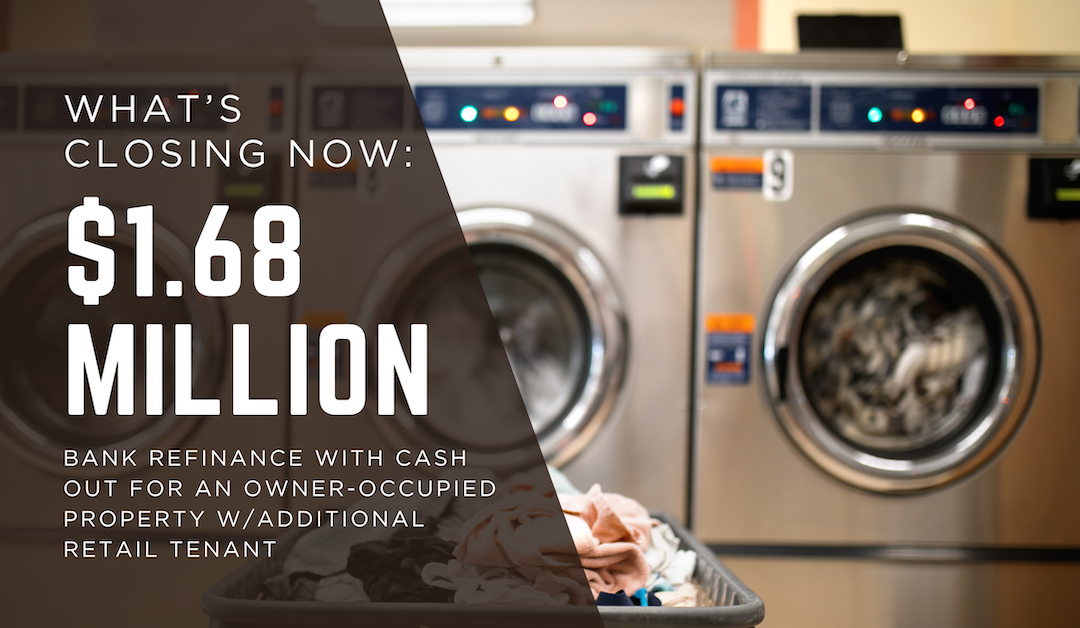
We recently closed a $1,677,000 cash-out refinance at a conventional bank for a South Florida business owner — and if you know how conservative banks have been with cash-out deals lately, you already understand why that sentence is worth stopping on.
This wasn’t just a refinance. This was a cash-out at the bank level, which means our client pulled real capital out of his property while simultaneously locking in a better rate, at an institution that ran the full global analysis and said yes to the whole package. He’s now deploying that cash toward his next acquisition. That outcome, for a borrower with a complex file and three prior declines, doesn’t happen by accident.
The borrower had genuinely strong fundamentals — an 814 FICO, a $9M net worth, and a cash-flowing portfolio he built from the ground up. But the deal got declined three times, nearly fell apart twice, and required navigating a language barrier, a disputed appraisal, and documentation that wasn’t anywhere close to bank-ready when we first saw it.
We got it done. Here’s how it actually went.
Why Getting a Bank Loan Is Harder Than People Think
There’s a reason we’re proud of this one, and it starts with understanding what “bank financing” actually means in the commercial real estate world.
A conventional bank loan on an owner-occupied commercial property isn’t like getting a mortgage on a house, or even like an SBA loan. There’s no government guarantee backstopping the bank’s risk. The bank is extending credit based entirely on the strength of the borrower and the deal — and they underwrite accordingly. That means a full global cash flow analysis across every entity the borrower owns, every income stream, every debt obligation. It means clean tax returns, organized P&Ls, a clear picture of how the property is being used and why. It means the kind of documentation discipline that most business owners, frankly, don’t have.
Banks reserve this kind of financing for their best borrowers. When the file isn’t clean — when there are gaps in the records, or the property doesn’t fit the standard definition, or anything else raises a question — they pass. Quickly.
So when we say we landed this borrower bank-level financing, we’re not just talking about a closed loan. We’re talking about getting a self-made entrepreneur into the top tier of the commercial lending market despite a file that would have ended the conversation at most institutions.
The Borrower and the Challenge
Our client started with one laundry business and built outward from there. By the time we met him, he had multiple operating locations, several commercial buildings, and a straightforward philosophy: own the real estate your business sits in. His companies were his tenants. It kept occupancy stable, kept cash flow predictable, and over time built him a net worth approaching $9 million.
His credit was excellent — an 814 FICO — and his debt coverage ratios were strong, above 1.3x for three consecutive years running, and well over 5x in the months leading up to closing. This was not a borrower in trouble. This was a borrower who deserved better financing than he had.
The problem was the property. It was split exactly 50/50 — his laundry business on one side, a grocery store tenant on the other. For most bank programs, owner-occupied commercial real estate requires the borrower’s business to occupy the majority of the space — typically 51% or more. At exactly half, this property didn’t fit the definition cleanly, and banks had a simple solution to that ambiguity: decline.
What Went Wrong — And How Many Times
Let’s be candid about the road this deal traveled.
🛑 The first appraisal came in too low. The initial valuation didn’t support the loan amount. Rather than accept it, we challenged the approach and pushed to have the property properly evaluated as owner-occupied commercial real estate — a classification that changes which comparables are used and how the income is weighted. It required persistence, but it was the right call.
🛑 The client wanted to try other banks. Understandably. When a deal stalls, you look for alternatives. He took it elsewhere. Those banks passed. Each one looked at the occupancy structure, the documentation, and the appraisal discrepancy — and stepped back.
🛑 The books and records weren’t perfect. This is more common than borrowers like to admit and more common than banks like to accommodate. Business owners build businesses; meticulous recordkeeping often comes second. Less-than-clean documentation doesn’t automatically mean a weak borrower — it just means there’s a lot of work to be done. And the work is often tedious – and sometimes expensive, when going through a CPA.
🛑 There was a language barrier. Our client’s primary language is Spanish. That adds real friction to a process that’s already technical and high-stakes. Working through it takes more time and more care.
🛑 The deal fell apart twice. Some files, especially complicated ones, have moments where everything stalls — the borrower gets frustrated, circumstances shift, communication breaks down. It happened here, twice. We kept the file alive and stayed ready for when the time was right to move again.
The Move That Unlocked the Deal: Getting the Classification Right
The thing that actually unlocked this deal was the appraisal classification.
Owner-occupied commercial real estate (OOCRE) and investment property are not the same thing — not in how they’re valued, not in how they’re underwritten, and not in which bank programs will touch them. When a property is evaluated as OOCRE, the comparable sales change, the income weighting changes, and the whole story the appraisal tells is different. In this case, that difference was the difference between a loan that worked and one that didn’t.
The classification was legitimate. Our client’s business was a genuine occupant of the property. The financing was for a genuine business purpose. But getting an appraiser to approach it the right way, and then getting a bank’s credit team to accept that approach after three prior declines had poisoned the well — that took persistence most people don’t have the patience for.
We’re not most people.
The Result: Cash out, Better Rate, and a Future Built on a Stronger Foundation
Our client was paying 8% on his existing debt. We closed him at 6% at a conventional bank — with cash out.
Let’s sit with that for a second. This is a borrower who had been turned down by other banks, whose property sat at an awkward 50/50 occupancy split, whose books required significant work to present properly — and he didn’t just get refinanced. He got refinanced at a lower rate, through a bank, with capital in hand to go buy his next property.
The cash-out proceeds are already earmarked for his next acquisition. That’s not just a closed loan — that’s momentum. That’s what access to the right financing at the right level actually does for a real estate investor who’s building something.
Beyond the numbers, what he now has is an institutional banking relationship that reflects what he’s actually worth. Future deals get easier. Lines of credit, expansion financing, the next refinance — all of it improves when a real bank has looked at the full picture and said yes. He earned that. We just made sure he got there.
Why This Is Harder Than It Looks — And Why We Don’t Walk Away
If you’ve been declined by a bank, here’s the honest explanation of what’s happening.
Banks aren’t built for complexity. They’re built for volume, efficiency, and risk management. When a file has unusual occupancy structures, documentation gaps, appraisal disputes, or communication challenges, the path of least resistance is a decline. It’s not personal — it’s institutional.
What that means for borrowers is this: a bank decline is not a verdict on your creditworthiness. It’s a verdict on whether your file, as presented, fits that bank’s process. Change how the file is structured and presented — fix the appraisal classification, contextualize the documentation, find the right lending program — and the answer can change.
When we see the full picture — strong credit, strong cash flow, real assets, genuine character — we commit. We don’t just submit a package and hope, but rather, we diagnose what’s creating friction, fix it – and utilize the bank or fund whose program actually matches the deal.
Talk to Us
If you own commercial real estate and you’ve been turned down — or if you’ve assumed that a bank cash-out refinance is out of reach because your file isn’t perfect — give us a call. It’s worth thirty minutes to find out what’s actually possible.
Commercial Capital Ltd., FL — (888) 959-1648 Or reach out online here.
Recent Comments