
Quick Answer: Can You Get an SBA Loan for a Startup Restaurant with Real Estate?
Yes — but it is significantly more complex than a traditional SBA 7a loan.
SBA startup loans for restaurants require:
• Strong borrower experience
• Sufficient equity injection (typically 15%)
• A defensible business plan and projections
• Careful structuring when real estate and construction are involvedPlus, restaurants are notoriously one of the most difficult industries to finance!
Not every lender can structure these deals. With the right experience, they can absolutely get done.
Startup loans are difficult. SBA startup loans involving a restaurant, real estate, construction, and pro forma projections are harder still — and this deal had all three.
But difficulty isn’t the obstacle most people think it is. The real question is whether the people structuring your deal have seen it before — and know exactly what to do when things get complicated.
We have. And we did.
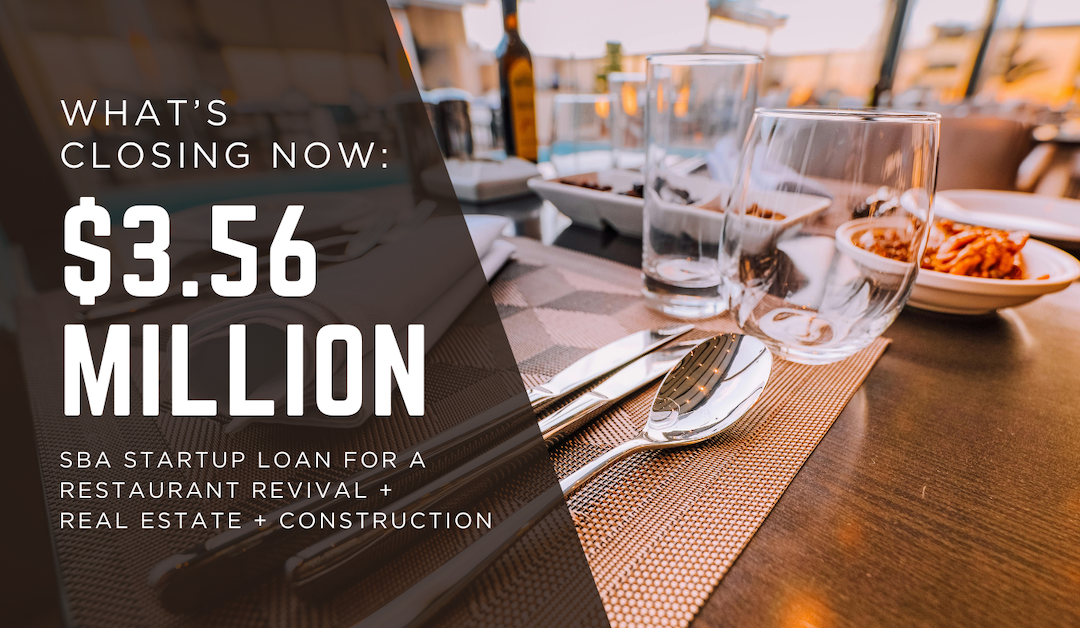
We recently closed a $3,560,000 SBA 7(a) loan for a startup restaurant and hospitality concept in Florida. The deal included:
- A full real estate acquisition
- Construction and renovation
- The revival of a previously failed restaurant (one of the most difficult industries to finance, in general)
- An approval based entirely on pro forma projections
This one was tough – it’s one of the most difficult industries to finance, and on top of it all – it took almost two years to secure all of the necessary permits. Often times, the lengthy permitting process is why these deals are lost. But we buckled in and stayed focused with our client.
The Deal: A Revival of a Failed Restaurant Location
This project centered on acquiring and redeveloping a 2+ acre commercial property in Florida that had previously operated as a well-known local restaurant. The prior business had closed abruptly, leaving behind existing infrastructure, strong community name recognition, and a set of operational issues the new ownership group was determined to correct.
Their vision was to transform the site into a multi-faceted hospitality destination with:
- Indoor and outdoor dining
- Live music and event space
- A marketplace featuring local vendors
- A food truck to generate revenue during construction
As outlined in the business plan, the concept was designed to become a community-centered destination with multiple, diversified revenue streams. We recognized the strength of that vision early — and structured the financing to match it.
What Made This SBA Loan Challenging
This was not a straightforward deal. It combined several of the most complex elements in SBA lending — simultaneously. Each one required deliberate structuring, proactive communication, and the kind of judgment that only comes from deep experience on both sides of a business transaction.
1. Startup + Pro Forma Underwriting
There was no historical business cash flow. The entire approval rested on the borrower’s experience, market viability, revenue projections, and the operational credibility of the plan.
Pro forma deals require lenders who are comfortable underwriting future performance rather than past results. Because we’ve built and operated businesses ourselves, we know how to evaluate whether a projection is grounded in reality — and how to present that case to an underwriter persuasively.
2. Real Estate + Construction
The loan covered property acquisition, renovations, and site infrastructure work. Construction components introduce timeline risk, budget oversight, additional documentation, and significantly more complex underwriting. Managing all of those moving parts simultaneously is something most lenders hand off or slow down on. We stay in front of it.
3. The Revival of a Failed Business
The property’s history raised a legitimate underwriting question: was the prior failure due to the location — or the operator?
We dug into the specifics, worked with the borrower to build a clear and well-supported case, and demonstrated that operational mismanagement — not weak market demand — caused the closure. Knowing how businesses actually fail, and why, gave us the credibility to make that argument effectively.
4. A Constantly Changing – and Lengthening – Timeline
Permitting and approvals stretched across nearly two years. Most lenders won’t stay engaged on a file that long. Deals like this often fall apart due to:
- Changing timelines
- Rising costs
- Borrower fatigue
- Lender disengagement
We stayed engaged because we understood how complicated permitting can get – and still believed in the vision.
5. Loss of a Partner Mid-Process
Partway through, the borrower tragically lost a partner — requiring real adjustments to the ownership structure, equity injection, and loan structuring. This kind of disruption ends deals far more often than it gets resolved. We thoughtfully restructured, adapted, and kept moving forward.
The Structure That Made It Work
Despite every complication, this deal closed — because the fundamentals were strong and we knew how to build around them:
- Experienced operator with solid credit
- A concept grounded in clear market understanding
- Multiple revenue streams built into the financial model
- Adequate equity injection, including family-supported capital
- A business plan reflecting operational reality, not optimistic speculation
The food truck component is a good example of how business-minded structuring makes a difference. Rather than waiting for construction to complete before generating any revenue, we helped architect a model where income could begin during the buildout — reducing risk, improving the loan profile, and demonstrating operational readiness to underwriters.
That kind of thinking doesn’t come from a lending checklist. It comes from having been in the operator’s seat.
Why Most Lenders Don’t Close Deals Like This
Most lenders approach complex SBA deals from a single angle: risk mitigation. They look for existing businesses with tax returns, clean financials, and uncomplicated transactions. When a deal involves a startup, construction, pro forma underwriting, and a multi-year timeline, many institutions simply decline to engage.
We approach these deals differently — because we’ve lived on both sides of them. We understand what it takes to build a business, which means we can evaluate a borrower’s plan with real depth, structure the financing with strategy, and manage the process with the experience of someone who knows what’s actually at stake.
That means adapting when ownership structures shift, staying engaged when timelines extend, and finding solutions when new variables emerge. It also means bringing a level of business judgment to the process that goes beyond what a traditional lender offers — because structuring a complex deal isn’t just a financing exercise. We stayed with it because it made sense — and because our job isn’t just to issue term sheets. It’s to close deals.
That’s not a marketing claim. This deal is the proof.
Thinking About a Startup or Complex SBA Loan?
If you’re exploring a startup business, a restaurant or hospitality concept, a real estate-backed SBA loan, or a project involving construction or redevelopment — the structure of the deal matters. So does the experience of the team behind it.
If you’ve been told “no” elsewhere, the problem may not be the deal. It may be who’s structuring it.
You can start your SBA pre-qualification online in under a minute, or call us at (888) 959-1648 to talk through your situation.
The right deals don’t always look simple. But with the right team — one that understands both lending and business — they get done.
Recent Comments