
💡 Key Takeaway
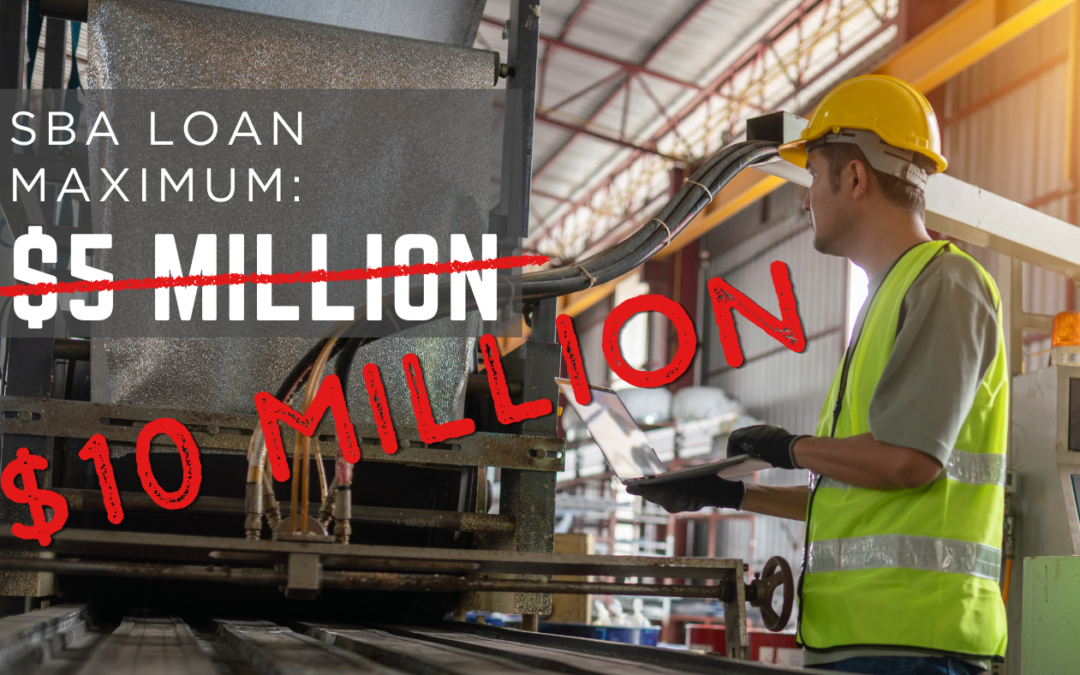
The SBA has doubled its manufacturing loan limit from $5 million to $10 million under the Made in America Manufacturing Finance Act. For qualifying domestic manufacturers, this means access to more capital for equipment, facility expansion, and onshoring — and for business brokers and commercial realtors, it means a larger pool of qualified buyers entering the market.
Introduction: A Rule Change That Flew Under the Radar
A manufacturer we work with recently got approved for an amount he’d been told wasn’t possible through SBA. Nothing changed about his business. One thing changed about the program.
The SBA updated its guidelines — financing for qualifying domestic manufacturers can now go up to $10 million. That’s double the old cap, and it didn’t exactly make headlines.
The change comes from the Made in America Manufacturing Finance Act, passed by the U.S. House and celebrated by SBA Administrator Loeffler as a major step toward strengthening domestic production and supply chains.
Whether you’re a manufacturer looking to grow, a business broker helping a client exit, or a commercial realtor watching buyer demand shift — this update matters. Here’s a clear breakdown of what changed, why it matters, and how to position yourself to benefit from SBA $10M manufacturing loans.
What Changed: The SBA $5M Cap Is Now $10M for Manufacturers
For decades, the SBA set a $5 million ceiling on loans for most programs, including the widely-used 7(a) and 504 loan programs. That ceiling became a real bottleneck for mid-sized manufacturers — businesses with strong cash flow and real assets that simply outgrew what SBA-backed buyers could finance.
Under the updated guidelines, qualifying domestic manufacturers can now access SBA-backed financing up to $10 million. The update targets:
-
- Manufacturers expanding U.S.-based production
- Companies investing in equipment or facility upgrades
- Businesses involved in onshoring or supply chain development
- Operators who previously hit the SBA ceiling and were turned away
How the SBA 504 Loan Structure Works at $10M
The SBA 504 program finances projects in three parts:
-
- 50% from a conventional bank or lender
- 40% from the SBA (now up to $10M for qualifying manufacturers)
- 10% from the borrower (down payment)
With the SBA portion now reaching $10M, total eligible project sizes can climb to $20–$25 million depending on lender participation. That opens the door for major facility expansions, full equipment line installations, and multi-phase capital projects that were previously out of reach for SBA-eligible borrowers.
Who Qualifies for SBA Manufacturing Loans Up to $10M
Not every manufacturing business automatically qualifies. The SBA’s expanded limit is targeted and tied to specific criteria. Eligible businesses typically include:
-
- Domestic manufacturers producing goods in the United States
- Companies involved in onshoring or bringing production back from overseas
- Businesses purchasing equipment, machinery, or expanding production facilities
- Manufacturers scaling operational capacity to meet domestic demand
- Companies that previously exceeded the $5M SBA cap and were turned away
It’s also worth noting that industry classification matters. NAICS codes associated with fabrication, precision manufacturing, CNC machining, industrial services, and similar sectors tend to align well with these guidelines. Your lender or financing advisor will assess eligibility based on use of funds, business type, and deal structure.
Why Structure Determines Whether You Get Approved
Here’s where most borrowers get tripped up: this is not a simple “apply and get $10M” situation.
Like most SBA programs, structure determines outcome. The difference between:
❌ “This doesn’t qualify”
✅ “This gets approved”
…often comes down to how the deal is positioned, how financials are presented, and which SBA program is used.
Key structural factors lenders and SBA reviewers evaluate include:
-
- Use of funds — is it clearly tied to manufacturing, equipment, or U.S. production?
- Business financials and EBITDA clarity
- Down payment and borrower equity contribution
- The specific SBA program (7(a) vs. 504) and lender preference
- How the project narrative aligns with the SBA’s manufacturing priorities
Working with an advisor who understands SBA deal structure — not just the loan limits — is the difference between an approval and a frustrating decline.
What This Means for Business Brokers
If you work with manufacturing business owners — helping them sell, plan exits, or navigate transitions — the $10M SBA expansion is directly relevant to the deals you’re working right now. The market backdrop makes this one of the most active windows for manufacturing M&A in years, and the financing change amplifies it significantly.
The Manufacturing M&A Market Is Accelerating
Manufacturing deal activity picked up sharply through the second half of 2025 and is carrying momentum into 2026. Global M&A deal value rose 40% in 2025, reaching an estimated $4.9 trillion, with advanced manufacturing and industrials playing a central role in that rebound. According to Bain & Company, more than 80% of private equity and corporate dealmakers expect to transact a greater volume of deals in 2026 than in 2025.
For business brokers, that translates to more buyers actively looking — and more sellers who may finally be ready to act. The manufacturing sector in particular is seeing strong demand driven by reshoring initiatives, supply chain restructuring, and the growing premium buyers are placing on U.S.-based production assets.
More Qualified Buyers in the $5M–$10M Range
Manufacturing companies in the $5M–$10M enterprise value range previously required private equity, family office capital, or complex multi-lender structures to finance. Now, individual buyers and first-time acquirers with solid industry backgrounds can access SBA-backed financing to compete at these valuations. Buyer pools expand. Deals close faster. And sellers get stronger, cleaner offers — often with less seller note exposure.
Private equity represented 42% of total capital invested in global industrials M&A in the first half of 2025, up from 25% the year before. That institutional competition is pushing individual buyers to move faster and structure more competitively. SBA financing gives them a real tool to do that.
Simpler Deal Structures Mean More Deals That Close
Deals that previously required large seller notes, equity injections from multiple parties, or complex layered financing can now often be handled with a single SBA lender. That means cleaner LOIs, fewer contingencies, and stronger deal certainty for your sellers. For brokers, fewer moving parts equals fewer deals that fall apart at the finish line.
Exit Timing Is Favorable — and the Window Won’t Stay Open Forever
Over 50% of U.S. manufacturing owners are above age 55, meaning the generational transfer wave isn’t coming — it’s already here. Manufacturing valuations typically run 4.5x–6.5x EBITDA, and with buyer demand elevated and financing more accessible than it’s been in years, sellers are in a strong negotiating position. According to Deloitte’s 2026 M&A Trends Report, one-third of all U.S. deal value in 2025 was driven by just 20 large transactions — which means there is ample opportunity for small and mid-size manufacturing deals for brokers who move early.
If your clients have been sitting on the sidelines, now is the time to revisit the conversation. Refer a loan here and we’ll handle the financing side.
What This Means for Commercial Real Estate Professionals
For realtors who work in the commercial and industrial space, the SBA’s expanded manufacturing limit creates a direct shift in buyer activity — and it arrives at an interesting moment in the industrial real estate cycle.
The Industrial Market Is Stabilizing — and Demand Is Shifting
After a construction surge that pushed national industrial vacancy rates higher through 2024 and into 2025, the market is now moving toward stabilization. New construction starts have fallen to 10-year lows, according to Plante Moran, while net absorption reached 176.8 million square feet in 2025 — a 16% increase over 2024, according to Cushman & Wakefield. That combination of reduced supply and rising demand points to a tightening market heading into 2026.
Small-bay industrial space — the kind most relevant to domestic manufacturers — is particularly constrained, with vacancy rates below 5% nationally. For commercial realtors, that means owner-user buyers need to move decisively, and financing readiness is a competitive advantage.
Industrial Properties Become More Financeable for Manufacturing Buyers
The SBA 504 program is already one of the most powerful tools for owner-occupied commercial real estate. With the manufacturing cap raised to $10M, buyers can now structure deals that include both the real estate and the operating business under a single SBA-backed transaction. Industrial buildings, warehouses, and production facilities that were previously out of reach for SBA-eligible buyers are now squarely in play.
This matters especially for manufacturing facilities in the $3M–$8M range — a segment that historically struggled to attract enough qualified, finance-ready buyers. The SBA expansion directly widens that buyer pool.
Reshoring Is Creating Real Demand for U.S. Industrial Space
One of the clearest trends driving industrial real estate in 2025 and 2026 is reshoring. Companies are bringing production back to the U.S. to reduce geopolitical risk, strengthen supply chains, and align with domestic demand. According to CohnReznick’s Manufacturing & Distribution M&A Report, buyers are placing a premium on businesses with localized U.S. production — and that demand flows directly into the real estate those businesses occupy.
Build-to-suit and owner-user projects are increasing as manufacturers seek purpose-built facilities aligned with automation and modern production needs. For commercial realtors, understanding how SBA financing supports these buyers makes you a more valuable advisor in industrial transactions.
More Buyer Activity, Better-Qualified Buyers
As more capital becomes available for manufacturing acquisitions and expansions, demand for industrial real estate follows. Understanding the SBA financing landscape helps you better qualify buyers before they tour properties — and helps you close deals that might otherwise stall over financing. You can also refer a loan to our team and we’ll take it from there.
SBA 7(a) vs. SBA 504: Which Program Applies?
Both major SBA programs can be relevant depending on how the deal is structured:
SBA 7(a) Loans
-
- Flexible use of funds (working capital, equipment, business acquisition)
- Longer repayment terms
- Available up to $5M generally; the new $10M limit for manufacturers may apply depending on program guidelines and lender
SBA 504 Loans
-
- Best for real estate and major equipment (fixed assets)
- Three-part structure: bank + SBA + borrower
- SBA portion now eligible up to $10M for qualifying manufacturers
- Total project size can reach $20–$25M
The right program depends on the use of funds, the size of the project, and the lender’s appetite. An experienced financing advisor can map out which structure gives your deal the best path to approval.
How We Help Manufacturers, Brokers, and Realtors Access This Capital
We work with domestic manufacturers, business buyers, and the professionals who advise them — brokers, realtors, CPAs, and attorneys — to structure SBA-backed financing that gets to the closing table.
That means:
-
- Reviewing your scenario to determine whether the $10M program applies
- Advising on deal structure before you approach a lender
- Connecting you with SBA-preferred lenders who understand manufacturing deals
- Positioning your application so it aligns with what reviewers are looking for
More capital is available. The businesses that access it are usually the ones who know how to ask for it the right way.
Ready to See If This Applies to Your Business?
Call us at (888) 959-1648 or submit a loan request online by clicking the button below. We’ll walk through your scenario and map out what’s possible.
Frequently Asked Questions: SBA Manufacturing Loans
Up to $10M
| Does every manufacturer qualify for the $10M SBA limit? | No. The expanded limit applies to qualifying domestic manufacturers under specific program guidelines. Eligibility depends on use of funds, business type, NAICS classification, and how the deal is structured. |
| What’s the difference between SBA 7(a) and 504 for manufacturers? | SBA 7(a) is more flexible and covers working capital, acquisitions, and equipment. SBA 504 is designed for fixed assets like real estate and major equipment, structured as a three-part loan. The $10M expansion is most clearly defined under the 504 program for manufacturers. |
| Can a business broker refer a client for SBA manufacturing financing? | Yes. We work directly with brokers and their clients. We also have a referral program with rewards based on your level of involvement. Call us or submit a request online to get started. |
| What total project size is possible with the new $10M SBA limit? | Under the SBA 504 structure (50% bank / 40% SBA / 10% borrower), an SBA portion of $10M can support total projects of $20–$25 million depending on lender participation. |
| What’s the fastest way to find out if my business qualifies? | Call us at (888) 959-1648 or submit a loan request online. We’ll review your scenario and tell you directly whether this program applies and how to structure it. |
| Is this relevant for commercial realtors selling industrial properties? | Yes. SBA 504 financing can cover owner-occupied industrial real estate, and the expanded manufacturing cap makes larger facilities more accessible to qualified buyers. Understanding this helps realtors better qualify buyers and close industrial deals. |
Recent Comments