

The SBA has revised its lending rules again — and this time, it revised its own revision. SOP 50 10 8.1 first went into effect August 14, and just as lenders were getting used to it, the SBA quietly walked back a few of the pieces that would have made deals harder to finance. The result is a lending landscape that looks meaningfully different from where it stood a few months ago, whether you're buying a business, buying the building it sits in, expanding into a new location, or refinancing.
Here's what's most likely to touch your deal, broken down by what you're actually trying to do.
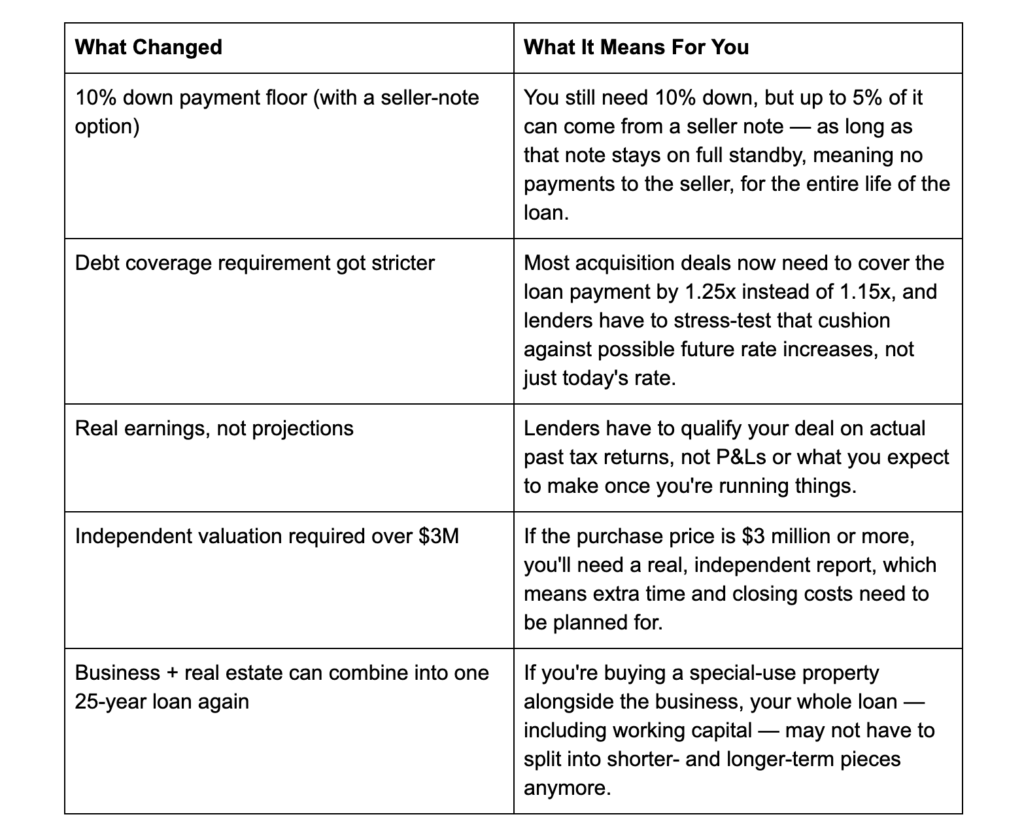
Now let's dig into what each of these actually means depending on the kind of deal you're doing.
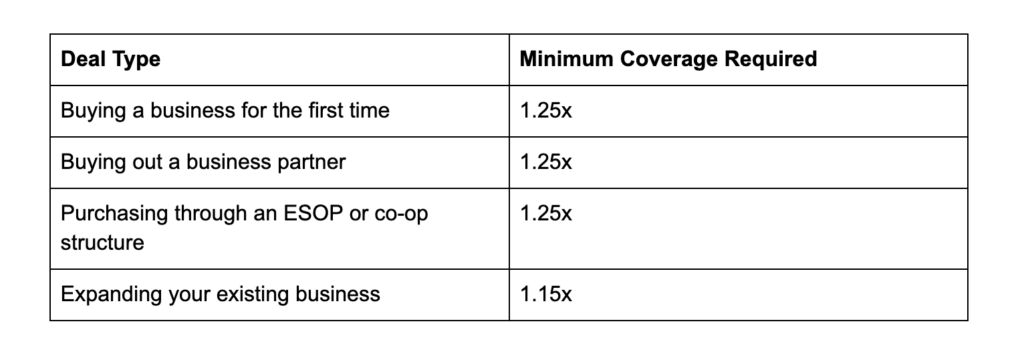
The biggest shift here is how a lender has to prove your deal can support the debt it's taking on. That test is called the debt service coverage ratio, or DSCR, and it's really just asking one question: does the business make enough money to comfortably cover the loan payment? That bar just got stricter. Most acquisitions now need to hit 1.25x coverage instead of the old 1.15x standard, and on top of that, lenders have to stress-test the deal against the possibility of future rate increases, not just whatever rate you'd be locking in today.
The exact number you'll need to hit depends on the kind of purchase you're making:
And here's the part that trips people up: that coverage number now has to come from the business's real, trailing financial performance (ie. filed tax returns). Projections about how much better things are running this year, or will run once you're the one in charge, can’t be relied on to greenlight the loan anymore - unless it’s a pure startup.
If your deal is $3 million or more, plan on an independent Quality of Earnings report as well – a deep, professional examination at whether the business's numbers actually hold up – prepared by someone the seller didn't hire. It adds a step, and it adds cost, but it's there to protect you just as much as the lender.
One more piece worth flagging is the new rules for underwriting a loan that includes a seller note. Lenders now have to count that note's payment as part of your debt service from day one of the loan, even if it's sitting on standby for the first couple of years. Before, that standby payment could be left out of the math entirely. Not anymore.
And if that seller note is being used to satisfy your required 10% equity injection, it has to stay on full standby for the entire length of the loan – which many sellers are unwilling to do.
One thing to keep in mind: even while it's on standby, that note starts collecting interest from day one. If your deal structure counts on the seller getting paid down or cashed out early, that's a conversation to have with your lender now, well before you're under contract.
This is the part of the story that actually got better, and it's good news if your deal involves a property the business genuinely couldn't operate without.
The August version of the rules would have forced these deals apart. The piece of your loan covering the business itself, plus any working capital, would have been capped around 10 years, while only the real estate portion could stretch longer — the two blended together into one weighted-average term. In practice, that meant a shorter runway and a noticeably higher monthly payment than buyers were used to.
The September 25th update reversed course for a specific kind of deal: when you're financing the business acquisition, working capital, and an owner-occupied special-purpose property all together, the whole loan can go back to amortizing as one, for up to 25 years, instead of splitting into shorter- and longer-term pieces. Think hotels, self-storage facilities, gas stations, or a purpose-built medical or dental office — anywhere the buildout is specific enough that it's hard to repurpose for a different type of tenant, and the business's value is genuinely tied to that one location.
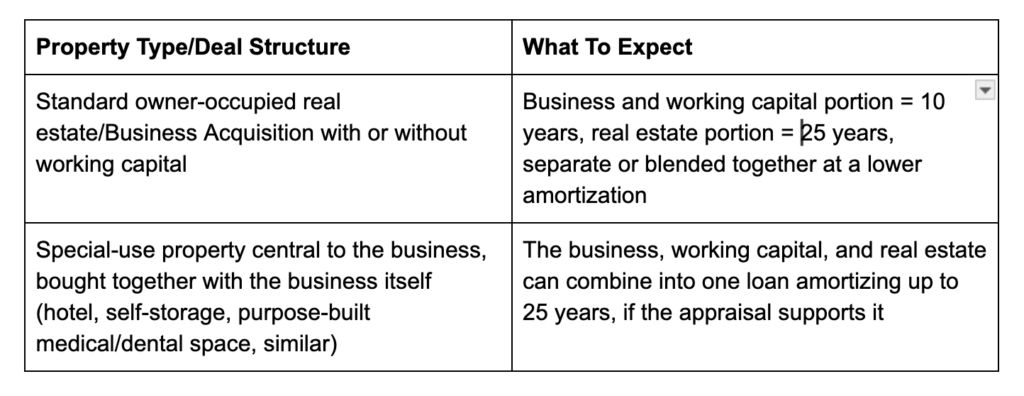
If you're buying something like a turnkey medical office, don't assume this automatically applies to you — it comes down to the appraisal. Make sure your appraiser specifically addresses why the property is special-purpose and how dependent its value is on the business itself. That's the evidence your lender will lean on to justify combining everything into one 25-year term.
If you already own a business and you're borrowing to grow — a second location, new equipment, a bigger footprint — you get a bit of a break here. The coverage requirement for expansion deals sits at 1.15x rather than 1.25x, and it's measured against the combined cash flow of your existing business and the new investment together, not the new piece on its own. That's a meaningfully easier bar to clear than what a first-time buyer is facing.
The headline changes in this update are mostly aimed at acquisitions and changes of ownership, not refinancing specifically. That said, the broader underwriting standards — how income gets verified, how properties get valued — flow into refinance files too, since the same SOP governs both the 7(a) and 504 programs. If you're planning to refinance out of a conventional loan and into SBA financing, it's worth a conversation with us before you assume your numbers will pencil the way they would have a few months ago.
Here's where most of the confusion has come from. The original guidance said the new rules would apply based on when the SBA issued your loan number. The September 25 update changed that: it now applies to any application the SBA actually receives on or after October 1. Anything received on or before that date stays under the current rules.
None of this means SBA financing got harder to use — it means it got more specific about proof. Lenders need cleaner numbers, better valuations, and more documentation up front than they did a year ago, and the deals that move fastest will be the ones where the business financials are clean and ready, are structured properly, and have appropriate closing timelines established before anything gets submitted.
That's exactly the kind of thing we spend our days doing. If you're working through an acquisition, a real estate purchase, an expansion, or a refinance and want to know exactly where your deal stands under the current rules, reach out to us at Commercial Capital Ltd., FL. Contact us at info@comcapfl.com or (888) 959-1648 to talk through your options, or get started in minutes by submitting your loan inquiry with Loan Finder: